Silver Halide Séance: The Darkroom Mystics Who Believe Film Can See What Lenses Can't
Photo: darkroom photography red safelight film development trays moody, via images.stockcake.com
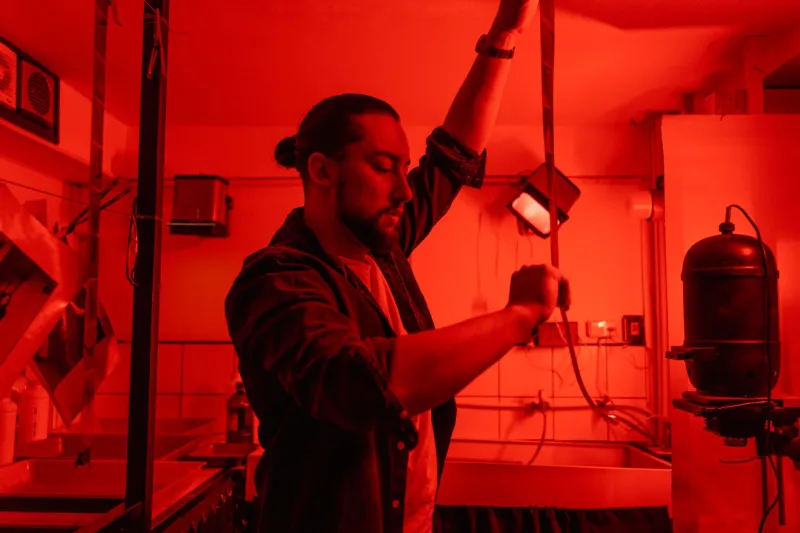
The first thing you notice when you step into Renata Voss's darkroom is the smell — developer chemicals mixing with something else, something faintly herbal, like dried lavender crushed into a fist. The second thing you notice is the silence. Not the polite quiet of a library, but the deliberate, almost pressurized silence of a ritual in progress.
Renata, a thirty-four-year-old photographer based out of Portland, Oregon, doesn't call herself a paranormal investigator. She doesn't call herself a medium, either. The label she keeps circling back to, reluctantly, is witness. "I'm just trying to keep the conditions honest," she says, her hands moving through a tray of fixer solution like she's reading something in the liquid. "If something is there, film will find it. Digital just... flattens everything into certainty."
She's not alone in that belief. Across the country — in converted garages in Austin, rented studio spaces in Brooklyn, and spare bathrooms in rural Ohio — a loose, largely unorganized community of photographers is reviving the aesthetics and, in some cases, the actual metaphysics of Victorian spirit photography. They're shooting on expired film, brewing their own chemistry, and treating the development process less like a technical procedure and more like an invocation.
The Ghost in the Grain
Spirit photography has a genuinely wild history. In the 1860s, a Boston photographer named William Mumler started producing portraits that appeared to show the ghostly figures of deceased relatives hovering near the living subjects. The grieving public ate it up. So did a lot of charlatans who followed in his footsteps, double-exposing plates and calling it communion with the dead. By the early twentieth century, the whole enterprise had been largely debunked, dismissed, and filed under "embarrassing chapter in photographic history."
But something funny happened on the way to the digital age. As film photography became a niche pursuit rather than a default one, the people who stuck with it started skewing toward the obsessive, the philosophical, and the genuinely weird. And some of them started asking: what if the Victorians were onto something, even if their methods were fraudulent? What if analog processes — the light-sensitive silver halide crystals, the chemical reactions, the physical imprint of photons on emulsion — created conditions that digital capture simply doesn't replicate?
That's not a fringe question in this community. It's the central one.
"Digital photography is essentially a translation," explains Marcus Okafor, a Chicago-based photographer who runs an informal workshop series he calls Aperture & Ether. "You're converting light into numbers and then back into an image. Film is a direct physical record. The light actually touches the material. There's no intermediary. And I think that matters, in ways we don't fully understand yet."
Marcus is careful to separate himself from the con-artist tradition. He's not selling grief-stricken widows images of their dead husbands. What he's doing is more experimental, more openly uncertain — and arguably more interesting for it.
Chemistry as Ceremony
The rituals vary practitioner to practitioner, but certain patterns emerge. Many in this community shoot in locations with documented paranormal histories: abandoned hospitals, old plantation sites, cemeteries that predate the Civil War. Some use modified development processes — pushing film beyond its rated ISO, pulling it back, experimenting with temperature variations that produce unexpected chemical reactions in the emulsion.
Others go further. Renata, for instance, incorporates what she describes as "intention-setting" into her darkroom process — a practice borrowed loosely from ceremonial magic traditions. Before developing a roll, she'll spend several minutes in silence, focusing on a specific question or location. She keeps a handwritten journal of every session, noting her mental state, the ambient temperature, and any anomalies in the resulting prints.
"I'm not claiming the photos prove anything," she's quick to say. "But the discipline of treating it like a ritual changes the way you look at the results. You slow down. You notice more."
That slowing-down aspect resonates across the community in ways that feel less supernatural and more deeply human. In an era of instant image gratification — of computational photography that automatically adjusts, corrects, and enhances before you've even lowered the camera — there's something genuinely countercultural about a process that demands patience, physical presence, and tolerance for ambiguity.
Where the Occult and the Analog Overlap
It's worth noting that this movement doesn't exist in a vacuum. It sits at the intersection of at least three larger cultural currents: the ongoing analog revival, the mainstreaming of occult aesthetics (thanks, in part, to a decade of witchcore and cottage-witch TikTok), and a renewed popular interest in paranormal investigation driven by everything from prestige TV documentaries to the enduring cultural footprint of shows like The X-Files and Ghost Adventures.
The paranormal investigation community has been particularly receptive. Several ghost-hunting groups around the country have started incorporating film photography into their investigations alongside the standard EMF meters and thermal cameras. The reasoning is partly philosophical — analog as a purer form of capture — and partly practical: film cameras are quiet, unobtrusive, and don't emit the electromagnetic fields that some investigators believe interfere with whatever they're trying to detect.
The results are, predictably, ambiguous. The community debates them constantly and passionately. Are the orbs and light streaks and strange double-exposures that occasionally appear in these photographs evidence of something genuinely unexplained? Artifacts of expired chemistry? The product of wishful pattern recognition? Probably all three, depending on who you ask and how charitable their epistemology is running that day.
The Print as Object
What's less ambiguous is the aesthetic power of the work being produced. Whatever you believe about the supernatural, the photographs coming out of this scene are frequently stunning — grainy, luminous, shot through with a quality of uncertainty that feels earned rather than filtered. They look like they're hiding something, which is perhaps the whole point.
For practitioners like Marcus, the physical print itself carries a significance that digital files simply can't replicate. "When I hand someone a print," he says, "that's the actual light from that room, that moment, chemically fixed into paper. There's a chain of physical causation connecting that image to whatever was present when the shutter opened. A JPEG doesn't have that. It's just data."
There's something almost theological in that formulation — the idea of the photograph as relic rather than record. And maybe that's the most honest way to understand what this community is actually doing: not conducting scientific investigations into the paranormal, but constructing a practice that takes mystery seriously, that refuses the comfortable certainty of the algorithm, and that insists on the possibility of the unseen.
In a culture that increasingly demands everything be legible, quantifiable, and instantly shareable, choosing to spend hours in a chemical-smelling darkroom waiting for an image to emerge from darkness feels like its own kind of resistance.
Renata holds a fresh print up to the safelight. There's a figure in it — or the suggestion of one, a smear of density in the corner that her eye keeps returning to. She tilts it slightly, studying.
"Maybe," she says. "Maybe not. That's kind of the whole thing."