Silver and Shadow: The Underground Darkroom Revival Turning Basements into Sacred Spaces
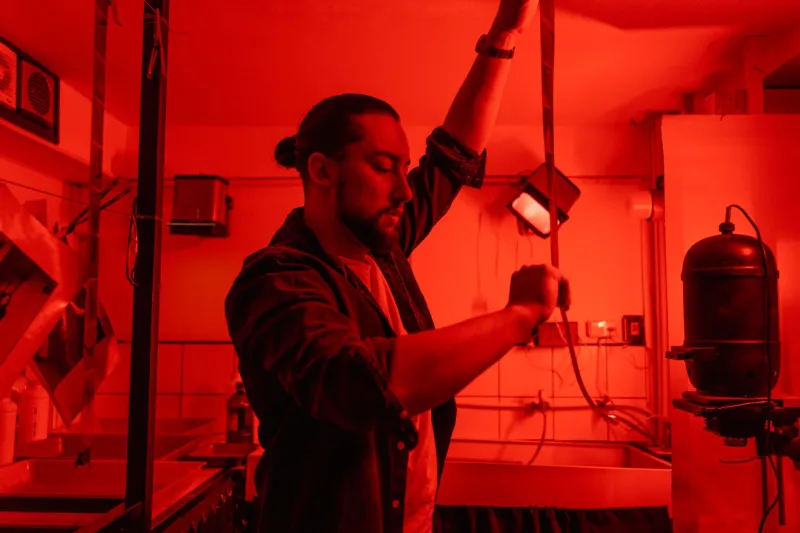
There's a particular kind of silence that settles over a darkroom at 2 a.m. It's not the silence of absence — it's the silence of waiting. Red light bleeds across the walls. The faint chemical bite of developer sits in the back of your throat. And then, slowly, a face emerges from white paper submerged in a tray of liquid, like something climbing out of the void to say I was here.
For a growing number of young Americans, this ritual — messy, slow, chemically dubious — has become something close to sacred.
The Basement as Sanctuary
Meet the analog archaeologists. They're millennials and older Gen Zers who've turned their rental basements, bathroom closets, and occasionally their landlord's forgotten storage rooms into functioning darkrooms. They're sourcing expired Ilford paper from eBay lots, mixing fixer from scratch, and light-sealing their spaces with the kind of obsessive attention to detail usually reserved for people who take their sourdough very seriously.
Some of these setups are technically illegal — either because they're violating lease agreements or because they're repurposing commercial or abandoned spaces without permits. In cities like Chicago, Detroit, and Philadelphia, photo collectives have quietly taken root in buildings that are, let's say, operating in a gray zone of occupancy. Nobody's advertising the address. You hear about it through a friend who heard about it through someone's Instagram DM.
"We don't own the space," says one collective member in Detroit who asked to be identified only by their darkroom handle, Fixer. "We just... use it. The building's been empty for three years. We brought in a safelight and a Beseler 23C and suddenly it's the most alive room in the neighborhood."
Why Now? Why This?
The obvious question is why. Digital photography has never been more democratized. Your phone shoots RAW files. Adobe Lightroom can make a mediocre snapshot look like a Magnum photo in about forty-five seconds. The tools of visual perfection are basically free and universally available.
And that, paradoxically, is exactly the problem.
For a lot of these practitioners, the frictionlessness of digital is the enemy — not because it produces bad images, but because it produces images that feel weightless. When you can shoot 500 frames in an afternoon and delete 490 of them before dinner, the individual photograph loses its gravity. It becomes disposable. Algorithmic. Optimized for a three-second scroll and gone.
Film doesn't work that way. A roll of 36 exposures demands that you actually think before you press the shutter. Development is a commitment — time, chemistry, darkness, patience. And the results are genuinely unpredictable in ways that no filter can replicate. Light leaks happen. Developer temperature drifts. Grain blooms across the shadows in ways that feel organic rather than applied. The imperfections are yours.
"I've been shooting digital for ten years professionally," says a photographer based in Brooklyn who runs a small darkroom out of her apartment bathroom. "I know how to get a technically perfect image. But I stopped feeling anything when I made them. The first time I pulled a print out of the developer and actually watched it appear — I cried. I'm not embarrassed about that."
The Black Market Enlarger Economy
Here's where it gets genuinely weird, and genuinely Voidfringe: the equipment market.
Darkroom gear was largely abandoned when digital took over in the early 2000s. Schools liquidated their photo labs. Newspapers dumped their processing equipment. A generation of enlargers, easels, timers, and chemical trays ended up in thrift stores, estate sales, and the deep back rooms of camera shops that somehow survived.
For a while, you could pick up a Durst M605 enlarger — a serious piece of German engineering — for twenty bucks at a Goodwill in Ohio. Those days are largely over. The word got out. Now there's a robust secondary market for vintage darkroom equipment that operates primarily through Facebook Marketplace, eBay, Craigslist, and a handful of dedicated forums where deals happen fast and shipping a 40-pound enlarger across the country is considered totally normal.
Some sellers have leaned into the demand hard. There are now small operations — barely businesses, really — that buy estate sale darkroom lots, refurbish the equipment, and resell it at a premium to urban photographers who don't have the time or geographic luck to source their own. It's a cottage industry built entirely on a technology most of the world declared dead twenty years ago.
Chemical supply has evolved similarly. While Kodak and Ilford still manufacture film and paper, darkroom chemistry is trickier. Some suppliers have scaled back or discontinued products. In response, a loose network of DIY chemists has emerged — people sharing formulas online, sourcing raw components from lab supply companies, and mixing their own developers from scratch. Caffenol, a developer made from instant coffee and vitamin C, has gone from internet curiosity to legitimate practice. The chemistry of photography, once proprietary and industrial, has been democratized and made strange again.
The Collective as Counter-Culture
What's most interesting about this resurgence isn't the technology or the aesthetics — it's the social architecture that's grown up around it. Darkroom work is inherently communal in a way that digital photography isn't. You can edit Lightroom presets alone in your bedroom at 3 a.m., but a shared darkroom requires coordination, trust, and a willingness to exist in physical space with other people who care about the same arcane thing you do.
Collectives have formed in most major US cities and a surprising number of smaller ones. Some are formal, with membership dues and scheduled access times. Others are pure anarchy — whoever shows up, works. Many organize around shared film stocks or printing styles, developing a group aesthetic that bleeds into zines, gallery shows, and Instagram accounts that somehow look completely different from everything else in your feed.
There's a politics to it, too, even if nobody's writing manifestos. Choosing analog in 2025 is a statement about what you value — slowness, materiality, process over product. It's a rejection of the attention economy's demand that everything be immediately shareable and endlessly optimized. A darkroom print exists in one place. You can hold it. You can smell the fixer on it. You can't compress it into a JPEG without losing something essential.
The Void Develops
None of this is going to replace digital photography. That's not the point, and the people doing it are the first to say so. What they're after is something harder to name — a kind of creative accountability that comes from working with a medium that doesn't forgive carelessness and can't be undone with Ctrl+Z.
The image that emerges from the developer tray is the image you made. All of it — the good choices and the bad ones, the perfect exposure and the accidental blur. It's yours in a way that a digital file, processed through algorithms and stored in a cloud server owned by a corporation, simply isn't.
In a cultural moment where authenticity is the most counterfeited commodity on the market, a lot of young photographers have decided that the only way to make something real is to make it by hand, in the dark, with chemicals that can stain your clothes and a process that has no undo button.
The void, it turns out, develops beautifully.