Leave a Message After the Beep: The Collectors Rescuing Voicemail Ghosts from the Landfill
Before texts, before DMs, before the read receipt, there was the beep — and whatever came after it. A small but fiercely devoted community of collectors is pulling vintage answering machines from thrift store bins and estate sale tables, restoring them to working order, and sitting in hushed rooms listening to voices that were never meant to outlive their moment.
This is not nostalgia in the Hallmark-movie sense. This is something stranger, more urgent, and a little bit haunted.
The Machine That Remembered
The answering machine had a good run — roughly four decades of cultural relevance, from the clunky reel-to-reel TAD-O-MATICS of the early 1970s to the blinking, cassette-driven workhorses of the '80s and '90s that became practically synonymous with American domestic life. They sat on kitchen counters and nightstands and home office desks. They blinked red when someone wanted you. They held secrets.
Then smartphones swallowed everything, and the answering machine disappeared so quietly that most people didn't notice it was gone until it already was.
Marcus Delray, a 38-year-old audio technician based in Albuquerque, noticed. "I found a GE two-cassette machine at a Goodwill in 2019 for three bucks," he says. "I plugged it in just to see if it worked, and there were still messages on it. A woman reminding someone about a dentist appointment. A guy who sounded nervous asking about Thanksgiving plans. I sat there for like twenty minutes just listening, and I couldn't throw it away after that."
Delray now owns over 140 machines, ranging from a 1971 PhoneMate Model 400 — a device roughly the size and weight of a car battery — to a sleek late-'90s AT&T digital unit that looks almost contemporary. He repairs them, catalogs them, and when they arrive with messages still intact, he archives the audio.
Artifacts of Unguarded Moments
What makes the answering machine such a compelling object for this particular breed of collector isn't the hardware itself — it's what the hardware preserved without anyone asking it to.
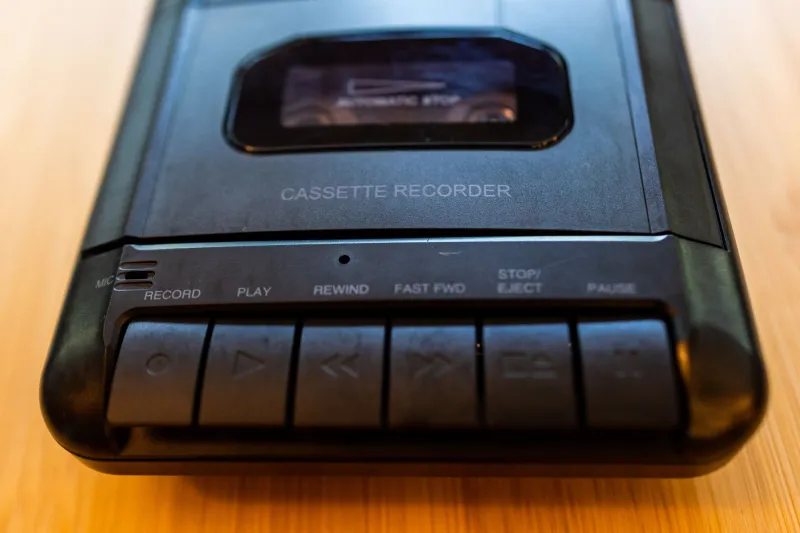
Voicemails were never designed as archives. They were meant to be heard once, maybe twice, and erased. But magnetic tape doesn't always cooperate with forgetting. Cassette-based machines from the 1980s and early 1990s, in particular, have proven unexpectedly durable. The messages encoded on their tiny internal tapes can survive decades in a garage or storage unit, waiting for someone with the right adapter and the right patience to press play.
"What you get is this completely unperformed version of a person," says Delray. "Nobody was thinking about how they sounded for the ages. They were just calling their mom or arguing with their landlord or leaving a birthday message. It's the most honest audio record of daily life that we have from that era."
That intimacy is exactly what draws people to these machines in an era when nearly every form of communication has been optimized, compressed, and filtered through some kind of algorithmic layer. The crackle of an old tape recording, the ambient noise of a 1993 kitchen bleeding through someone's voice — it's proof of a moment that actually existed, in a world that increasingly feels like it's running out of those.
The Repair Ritual
Restoring a vintage answering machine is not a casual hobby. These devices were built to be functional, not serviceable, and sourcing replacement belts, capacitors, and pinch rollers for a 30-year-old consumer electronics product requires a combination of eBay archaeology, hobbyist forum deep dives, and occasional improvisation.
Joanna Fisk, who runs a small repair and restoration operation out of her Portland, Oregon garage under the name Relic Ring, describes the process as something close to surgery. "Every machine has its own personality," she says. "Some of them come in clean and just need a belt swap. Others have been sitting in humidity for years and the whole mechanism is basically a crime scene."
Fisk got into the hobby through her background in consumer electronics repair, but she describes a shift in how she thinks about the work. "It stopped being about the machine pretty fast. Now it's about what the machine holds. I treat every one that comes in with messages on it like it's carrying something irreplaceable — because it is."
Her current project is a Panasonic KX-T1450 from the late '80s that arrived with eleven messages still on the outgoing cassette. She's documented all of them. One is a child leaving a rambling update about a school project for someone she calls "Grandma Pat." Another is a man, voice tight with something unnamed, saying he'll try again later. He never did, at least not on that machine.
The Community at the Edge of the Dial Tone
This is a small world — a few hundred dedicated collectors scattered across the country, connected through Discord servers, niche subreddits, and occasional meetups at vintage electronics fairs. It doesn't have the mainstream visibility of vinyl collecting or even the cult cachet of VHS hunting, and most of its participants seem to prefer it that way.
There's a shared ethic around the archived messages that the community has developed organically. Messages are never shared publicly with identifying information. If a machine comes in with a return address or a phone number still legible on the outgoing greeting, that information stays private. The goal isn't exposure — it's preservation.
"We're not trying to go viral," says Delray. "We're trying to hold onto something. There's a difference."
That distinction matters in a media environment where the impulse to broadcast everything can flatten the significance of anything. The answering machine collectors are practicing a kind of deliberate obscurity, building an archive that exists mostly for its own sake.
Why Now
It's worth asking why this particular object is generating this particular kind of devotion at this particular moment. The easy answer is pandemic-era nostalgia, the mass retreat into analog comfort objects that accelerated after 2020. But the collectors themselves push back on that framing.
"It's not about wanting to go back," says Fisk. "It's about understanding what we traded away. We traded permanence for convenience. We traded texture for speed. And I don't think most people have really sat with what that cost."
The answering machine, in this reading, isn't a relic of a simpler time — it's evidence of a different relationship with communication, one in which a message left was a message that lingered, that occupied physical space, that could not be unsent or deleted with a thumb swipe.
In an age of ephemeral stories and disappearing DMs, that lingering starts to look less like a limitation and more like a feature.
Somewhere in Albuquerque, a woman is reminding someone about a dentist appointment. The appointment is long past. The machine is still running. The tape still turns.
Leave a message after the beep.