Magnetic Ghosts: The Quiet Army Rescuing Homemade Cassette Tapes Before Time Eats Them Alive
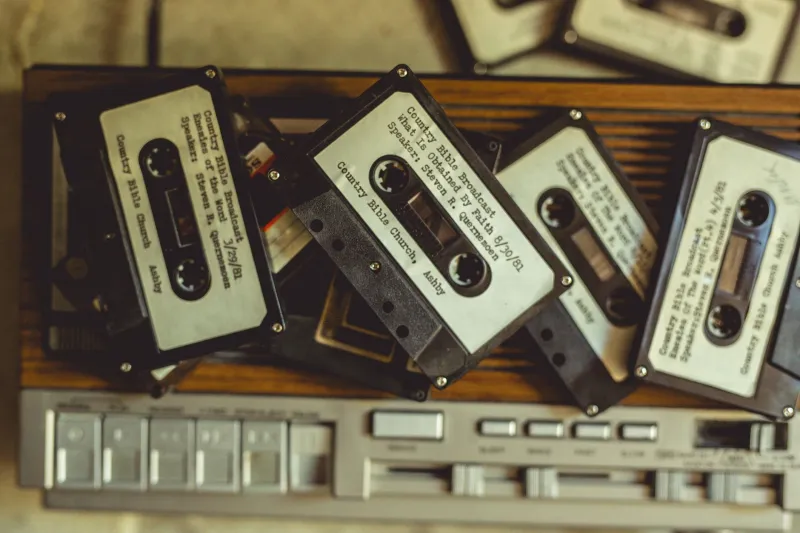
Somewhere in a basement in Akron, a guy named Derek is spending his Saturday feeding thirty-year-old cassette tapes through a deck he bought for twelve bucks at a Goodwill. The tape hisses. A voice crackles through — a teenager, probably, recording themselves singing into a handheld mic sometime around 1991. Nobody famous. Nobody who ever got a record deal. Just a kid in a bedroom making something real.
Derek is not related to this person. He found the tape in a box at an estate sale. He doesn't know if anyone alive remembers it exists. But he's going to digitize it anyway, upload it to a shared archive, and tag it with every scrap of metadata he can squeeze from the J-card. Because if he doesn't, the magnetic particles clinging to that plastic ribbon will keep degrading, and one day soon it'll just be noise — or silence.
This is what the cassette preservation underground actually looks like. Not glamorous. Not monetized. Just obsessive, patient people racing a physical clock that ticks whether they show up or not.
The Decay Nobody Talks About
Here's the thing about magnetic tape that most people don't think about until it's too late: it's not archival. The binder that holds iron oxide particles to the polyester backing breaks down over time, especially in tapes that were stored in attics, garages, or anywhere with temperature swings. The result is a phenomenon archivists call sticky shed syndrome — the tape literally gums up on playback heads, squealing and sticking and sometimes snapping entirely.
Professional institutions like the Library of Congress have known about this for decades. They've got climate-controlled vaults and restoration labs and federal funding. What they don't have is any particular interest in the bedroom four-track demo your cousin's punk band pressed in 1987 for a hundred bucks and handed out at shows in Cincinnati. That's not a knock on them — it's just the reality of institutional priority. The canon gets preserved. Everything else takes its chances.
Which is exactly where the underground steps in.
Online communities — scattered across Discord servers, Reddit threads, and dedicated forums with names that sound like they were designed to be unfindable — have quietly built out a distributed preservation network over the past decade. Members share equipment tips, coordinate tape-baking tutorials (a legitimate, if risky, process of heating tapes in a food dehydrator to temporarily restore playability), and maintain shared digital repositories that have no corporate backing and no guarantee of permanence beyond collective will.
What They're Actually Saving
Ask anyone in these circles what kinds of tapes they're after and you'll get a list that reads like a museum of everything the music industry ignored. Local band demos from the pre-internet era, when the only way to distribute your sound was to physically hand someone a cassette. Answering machine tapes with years of messages still on them. Home recordings of radio broadcasts from stations that no longer exist. Voice diaries — some people just talked to their tapes the way others journaled, narrating their days into a handheld recorder.
And then there are the proto-podcasts. Before RSS feeds and podcast apps, people were making serialized audio content and distributing it on cassette through zine networks and mail-order catalogs. Some of it was political. Some of it was weird fiction. Some of it was just someone ranting into a mic about whatever was pissing them off that week. None of it got preserved by anyone with a budget.
"There's this whole sonic vernacular that existed entirely outside commercial channels," says one archivist who goes by the handle Ferricoxide on the forums and prefers not to use their real name. "It's not lesser than what got released. It's just different. And it's disappearing faster than anyone's admitting."
The Compression Wars
Of course, nothing in the preservation underground is without its philosophical fault lines. The biggest ongoing argument — and it gets heated — is about file formats.
On one side, you've got the pragmatists: people who argue that a 320kbps MP3 is good enough for most purposes, takes up reasonable storage space, and can be easily shared and backed up across multiple platforms. Preservation is only useful if people can actually access what you've preserved, they argue. A perfect-quality file sitting on a dead server helps nobody.
On the other side are the purists, and they will absolutely die on this hill. For them, anything less than a lossless format — FLAC being the most commonly cited — is a betrayal of the original medium. The argument isn't just technical. It's almost ethical. If you compress a cassette recording into an MP3, you're making permanent decisions about what sonic information matters. You're encoding your own assumptions about quality into what's supposed to be an act of neutral preservation.
"Tape has this warmth, this texture," Ferricoxide explains. "Some of that texture lives in frequencies that lossy compression throws away. You're not just archiving the song. You're archiving the artifact. And the artifact includes the hiss."
The hiss argument is genuinely interesting. For most of recorded music history, noise reduction was considered unambiguously good — the whole point of Dolby B and C was to minimize tape hiss so the music could come through clean. But for these archivists, the hiss is data. It's evidence of the medium, the era, the specific physical object that someone held in their hands. Stripping it out in post feels like whitewashing.
The Ethics of Other People's Memories
There's another tension that doesn't come up as often but probably should: what happens when the tapes are personal?
Not every cassette in a thrift store box was made for an audience. Some of them were voice diaries. Some were letters recorded for family members who never came back. Some were therapy exercises, or arguments, or kids talking to themselves in the dark. When you digitize those and upload them to a shared archive, you're making a decision about someone else's private life.
Most archivists in these communities take this seriously. There are informal protocols — nothing with identifiable personal information gets shared publicly without a waiting period, or without attempts to locate living relatives first. But informal protocols are only as strong as the people following them, and the community is decentralized enough that enforcement is basically nonexistent.
It's the kind of ethical gray zone that the preservation underground tends to sit with rather than resolve cleanly. Because the alternative — doing nothing, letting the tapes decay, letting those voices dissolve into magnetic dust — feels worse.
Why It Matters
The easy cultural argument for cassette preservation is the one about history: that a complete record of any era has to include the stuff that didn't make it into the official channels. The bedroom recordings and the local scene demos and the voice diaries aren't footnotes to culture — they're the actual texture of it, the thing that tells you what it felt like to be alive in a particular place at a particular moment.
But there's something else going on here too, something that feels specific to this particular moment. We've spent the last decade and a half handing our cultural production over to platforms — streaming services, social media, corporate cloud storage — and watching those platforms make decisions about what survives. Algorithms decide what gets recommended. Companies decide what gets taken down. Servers get decommissioned.
The cassette archivists are operating from a different premise: that preservation is too important to delegate. That if you want something to survive, you have to put your hands on it yourself.
Derek in Akron probably won't save everything. Neither will Ferricoxide, or the dozens of other people in these communities spending their weekends on tapes nobody else cares about. But they'll save some of it. And some of it, it turns out, is everything.