Quarters for the Dead: The Urban Explorers Mapping America's Last Dead Mall Arcades
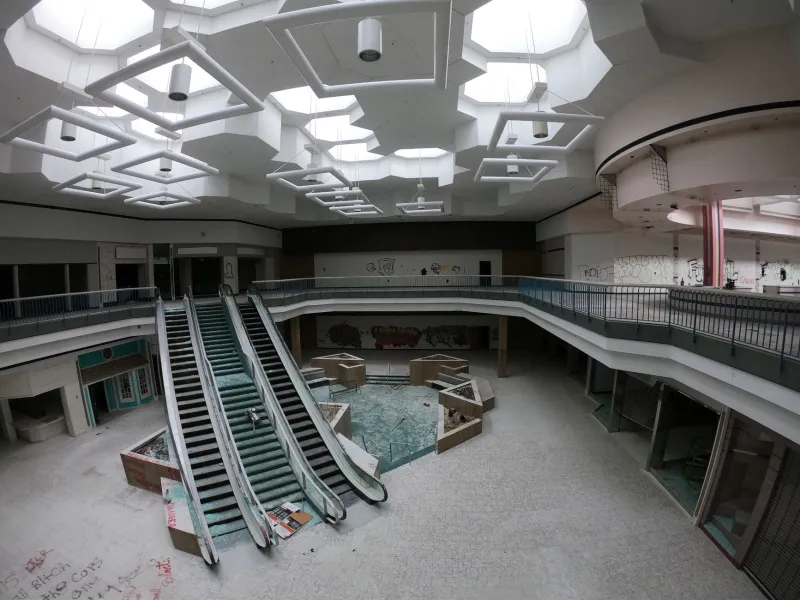
There's a specific sound a dead mall makes. It's not silence, exactly — it's the HVAC system humming over empty atriums, the echo of a space built for ten thousand sneaker-clad footsteps that now hosts a single security guard's rounds. And in maybe a dozen malls across the country, buried behind chained fire doors and dropped ceilings, there's another sound entirely: nothing at all, coming from rooms that once screamed with pinball chimes and Mortal Kombat voice clips.
The people who find those rooms call themselves a lot of things — urban explorers, arcade archaeologists, in one Michigan Discord server, 'the token ghosts.' What they share is a compulsion to document the final days of the American video arcade before the bulldozers get there first.
The Cabinet Graveyard Is Real
Ask anyone under forty what happened to arcades and you'll get a shrug. Ask the explorers and you'll get coordinates.
When a mall arcade dies — and most died between 2005 and 2015, squeezed by home consoles and dying foot traffic — the machines often stay. Demolition clauses, liquidation paperwork, and plain old landlord indifference mean cabinets can sit in the dark for a decade. The explorers know this. They watch mall death like hawks: local news reports of anchor stores closing, Reddit threads on r/deadmalls, foot traffic scouted in person.
Then they go in. Usually legally gray, occasionally with permission from security guards who'd rather have someone watching the place than nobody. What they find inside reads like a time capsule with a coin door.
One explorer, who goes by 'SkeeBallSal' online and asked that her real name stay out of print, described walking into a shuttered Ohio arcade in 2023: 'There was a Time Crisis 2 still loaded with tickets. A Galaga with the high score screen still lit. Some kid's initials from probably 2009. It's a museum nobody curates.'
Cartography of the Condemned
The documentation itself has become an art form. Explorers photograph cabinets in long-exposure detail — the faded side art, the CRTs with their phosphor burn ghosts still faintly visible, the grime patterns where a thousand teenagers leaned in for a clutch shot.
But the real currency of this community is the hand-drawn map.
These aren't blueprints. They're annotated floor plans, often sketched on notebook paper or in shared design apps, marking which machines are still powered, which still accept quarters, which have working joysticks versus frozen ones. A good map might note 'TMNT cabinet — 4-player, sticks loose but playable' or 'Do NOT touch the Star Wars cockpit, ceiling leak above it.'
Maps get traded like contraband in private servers. Locations are deliberately obscured — the community learned early that a viral TikTok means a looted arcade, cabinets gutted for collectible boards and sold to collectors while the explorers slept.
'There's an etiquette,' says a moderator of one exploration forum who goes by VoltageVandal. 'You photograph, you don't take. You don't share exact addresses publicly. You don't tag the location on social media, ever. We're archivists, not scavengers.'
Why Bother Documenting a Decaying Cabinet?
The obvious question: who cares about a water-stained Cruis'n USA?
The answer, according to the people doing this, is that arcades were one of the last genuinely communal third places America built for teenagers — spaces where you showed up, saw who else showed up, and competed face to face. The home console killed that, and the smartphone killed what was left. What remains in those dead mall back rooms is the physical infrastructure of a social world that no longer exists.
There's also a preservationist urgency. Arcade cabinets were never built to last. CRT monitors degrade, capacitors leak, the plywood cabinets swell with humidity. Unlike vinyl records or film negatives, which have passionate restoration communities and established archives, arcade history is being lost in real time, cabinet by cabinet, mostly in buildings scheduled for demolition.
Some explorers have gone further than documentation. A handful have negotiated salvage rights with landlords, extracting working cabinets from condemned malls and restoring them in home game rooms and barcades. A few have partnered with the Video Game History Foundation, donating photographs and serial numbers to help track rare machines — including, in one celebrated case, a prototype cabinet found in a Wisconsin mall that had been unaccounted for since 1994.
The Race Against the Wrecking Ball
The clock is unforgiving. Industry trackers estimate that of the roughly 4,000 malls operating in the US in the 1980s, only a fraction remain fully functional, and dead-mall demolitions have accelerated. Every arcade left standing is one insurance inspection away from a dumpster.
The explorers know they're losing. 'We're not saving these machines,' Sal admits. 'We're writing their obituaries. But somebody should.'
There's something fitting about it — the last players of the high score era sneaking through food court ruins to bear witness, flashlights instead of quarters, cameras instead of joysticks. The games kept score once. Now the explorers keep score for them.
Somewhere in a dying mall in the American Midwest, there's a cabinet with a CRT still glowing faintly in the dark, waiting for the grid to go off for good. Someone has already mapped the way to it. Someone already photographed the initials on the high score screen.
When the building comes down, that photograph will be the last proof it ever lit up at all.