The Two-Viewer Gospel: How 3 A.M. Streamers Built the Internet's Most Honest Rooms
The Loneliest Slot on the Internet
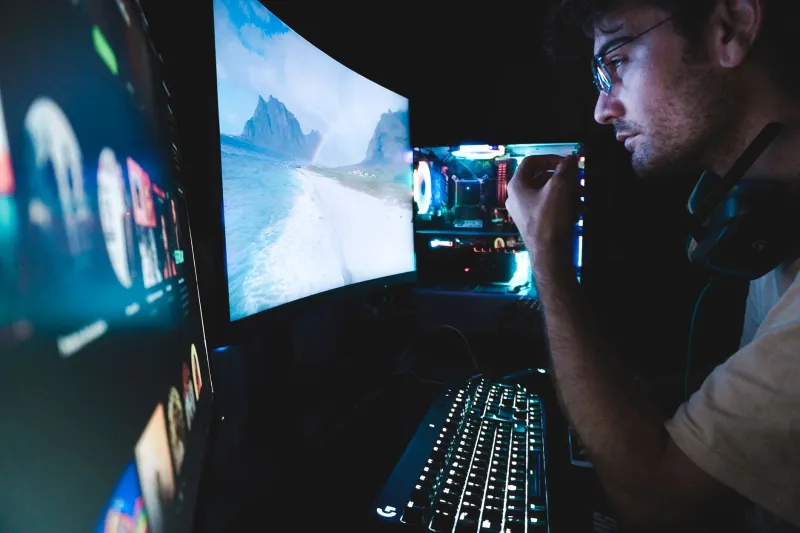
There's a version of the internet that most people never see. It's not the trending page or the algorithmic highlight reel. It's the 3 A.M. tier — the dead hours when viewership graphs flatline and the only people left awake are the ones with nowhere else to put themselves.
That's where you'll find Marcus, a 34-year-old warehouse worker in Columbus, Ohio, who streams lo-fi guitar sets to an audience that rarely cracks double digits. On a good night, he gets eleven viewers. On a bad night, two. He treats both nights exactly the same.
"People think streaming is about the numbers," he told me over Discord voice chat, his voice hoarse from a shift that ended at midnight. "The numbers are daytime thinking. At 3 A.M., you're not performing. You're keeping someone company. That's a different job entirely."
Nobody's Watching. Everybody's Watching.
The economics of live streaming are brutal and well-documented: platforms reward scale, scale rewards consistency, and consistency rewards the same three content formats on loop. Which is why the overnight slot — statistically the worst time to broadcast in every US time zone — has become an accidental sanctuary.
The people who stream at 3 A.M. Eastern aren't chasing the algorithm. They can't win it. So they've stopped playing.
Instead, the nocturnal scene runs on a different currency: recognition. Regulars call each other by name. There's a trucker who tunes in from rest stops outside Amarillo. A hospice nurse in Portland who watches on mute during her breaks. A college kid in Tampa whose sleep schedule has been "a suggestion" since 2021. They know each other's inside jokes. They notice when someone's missing.
Sociologists have a term for this — parasocial interaction — but it feels too clinical for what's happening in these chat windows. When the same six people show up night after night, the word "community" stops being marketing language and starts being literal.
The Night Shift Is a Country
America has always been a nation of night workers — roughly 15 million people clock in after dark, according to Bureau of Labor Statistics data — and the overnight streaming world is, in part, their answer to a culture built for day people.
The 24-hour diner used to be that infrastructure. So did the late-night radio DJ, the all-night truck stop, the cable access channel running infomercials into the void. Each one offered the same thing: proof that somebody else was awake.
The 3 A.M. streamers are the latest iteration of that lineage, whether they know it or not. Some absolutely do. A retired DJ in Detroit who goes by "Nightbird" on a small platform told me she deliberately models her streams on the overnight radio shows she grew up with — the slow talk, the dedication readouts, the sense that the host is sitting in the dark with you.
"Larry Lovers, Art Bell, all of them," she said. "They understood something the daytime people never got. At night, people don't want to be entertained. They want to be acknowledged."
Two Thousand Versus Two
Here's where the overnight scene inverts everything the creator economy holds sacred. A daytime streamer with 2,000 viewers is managing a crowd — moderating chat, pacing content, performing energy. A 3 A.M. streamer with two viewers is having a conversation.
The intimacy is structural. You cannot hide in a chat of two. Someone asks how your mom's surgery went and waits for an answer. Someone mentions they haven't eaten today and the streamer stops mid-song to make them promise they'll get a sandwich. These are not the interactions of mass media. They're the interactions of a porch.
And paradoxically, that intimacy is becoming a draw. A handful of larger streamers have started experimenting with deliberately small, overnight "quiet streams" — no gameplay, no hype, just ambient presence — precisely because their big audiences started feeling hollow. The skeleton crew hours, it turns out, offer something a raid can't: undivided attention, in both directions.
Keeping the Light On
Not every night stream is cozy. The overnight internet has its shadows — doomscrolling, gambling streams, the specific despair of content farmed at 4 A.M. by someone who should be asleep. The insomniacs I spoke to were quick to acknowledge it. The dead hours don't cure loneliness; they just make it more honest.
But there's something quietly radical about a person who broadcasts to nobody and everybody, who shows up at 3 A.M. because two people might need the light on. It's the same logic as the porch light left burning, the diner sign flickering on the highway — a small, stubborn signal that says someone's here.
Marcus put it better than I could. "People ask why I don't just stream during peak hours, grow the channel, do it right. And I tell them: I already did it right. There's a nurse in Portland who says my streams get her through her shifts. You can't scale that. Why would you want to?"
Somewhere in America, right now, someone is going live to an audience of two. Both of them are showing up tomorrow night. In the dead hours, that counts as a packed house.